
Why OEE Alone Does Not Explain Factory Performance
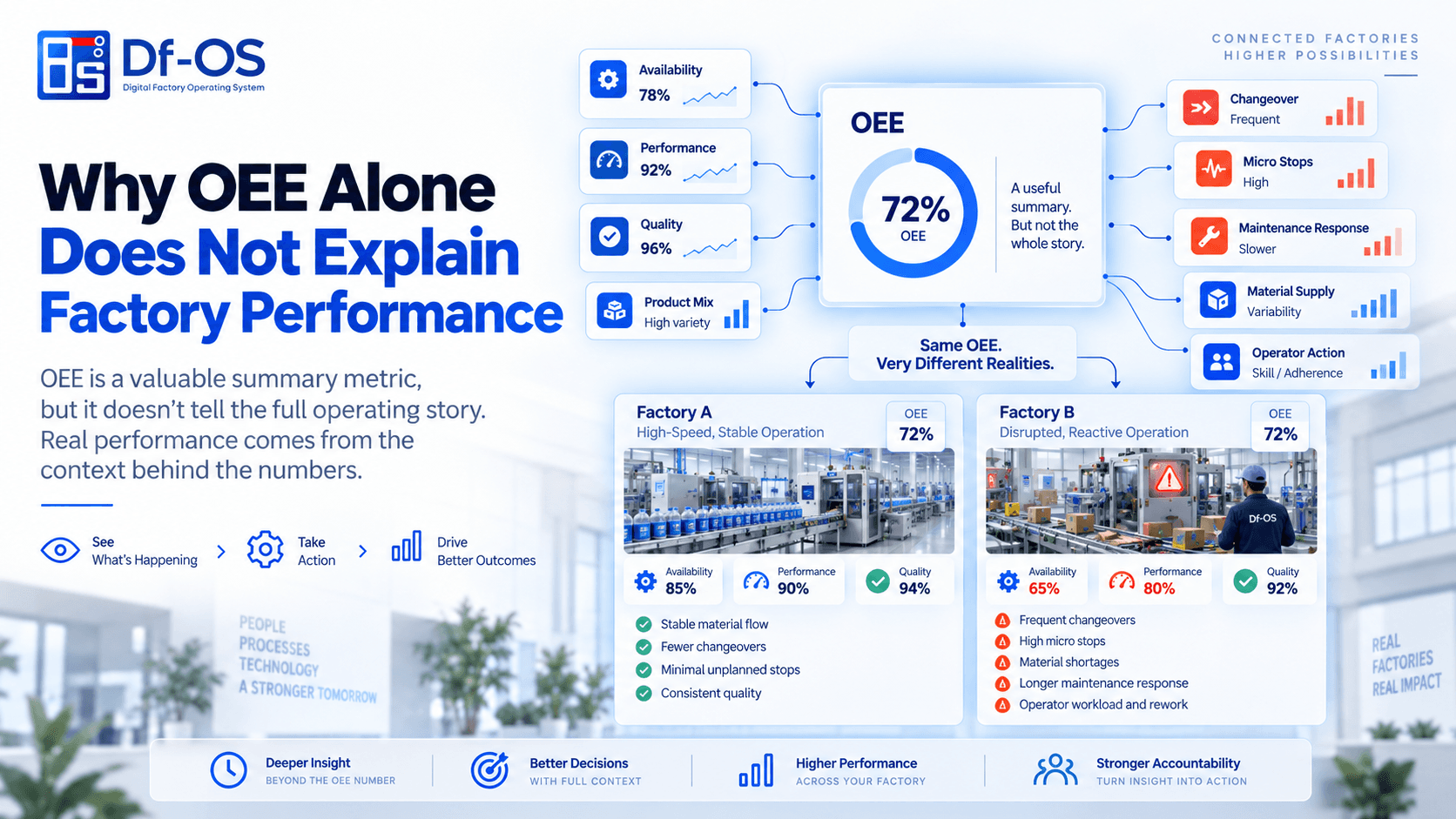
OEE is a useful measure of availability, performance and quality, but it does not fully explain why performance changed. Factory leaders also need context such as product mix, changeover, material, micro stops, maintenance response, operator action and unresolved workflow conditions.
OEE is one of manufacturing's most useful summary measures. It is also one of the most overburdened.
Overall Equipment Effectiveness combines availability, performance and quality into one result. It helps factories see how much productive potential was lost.
What it does not always explain is why the loss occurred and what the plant should do next.
What OEE does well
OEE creates a common language for three major forms of loss.
- Availability: Was the equipment available when it was planned to run?
- Performance: Did it run at the expected speed?
- Quality: Did it produce good output?
This makes OEE useful for trend review, line comparison and improvement focus.
The problem begins when the plant treats the final percentage as the complete operating story.
The same OEE can hide different factories
Two lines may report the same OEE and require completely different actions.
Line A has one long mechanical breakdown. Line B has many short stops, a slow changeover and repeated speed loss. The percentage may look similar, but the improvement path is not.
OEE needs context.
The context behind availability
Availability loss can come from:
- Breakdown
- Planned maintenance overrun
- Material shortage
- Cleaning
- Changeover
- Quality hold
- Safety restriction
- Waiting for approval
If the system records all loss as downtime, the plant may misdirect maintenance attention toward a workflow or planning problem.
The context behind performance
Performance loss can include:
- Micro stops
- Reduced line speed
- Product or pack complexity
- Material variation
- Temporary machine condition
- Operator adjustment
- Upstream or downstream imbalance
A speed loss may be a deliberate response to quality risk rather than poor operating discipline.
The context behind quality
Quality loss can depend on:
- Material lot
- Process variation
- Machine condition
- Inspection delay
- Startup scrap
- Changeover setting
- Rework definition
- Sampling method
The quality number is useful, but the decision depends on these relationships.
The OEE plus context model
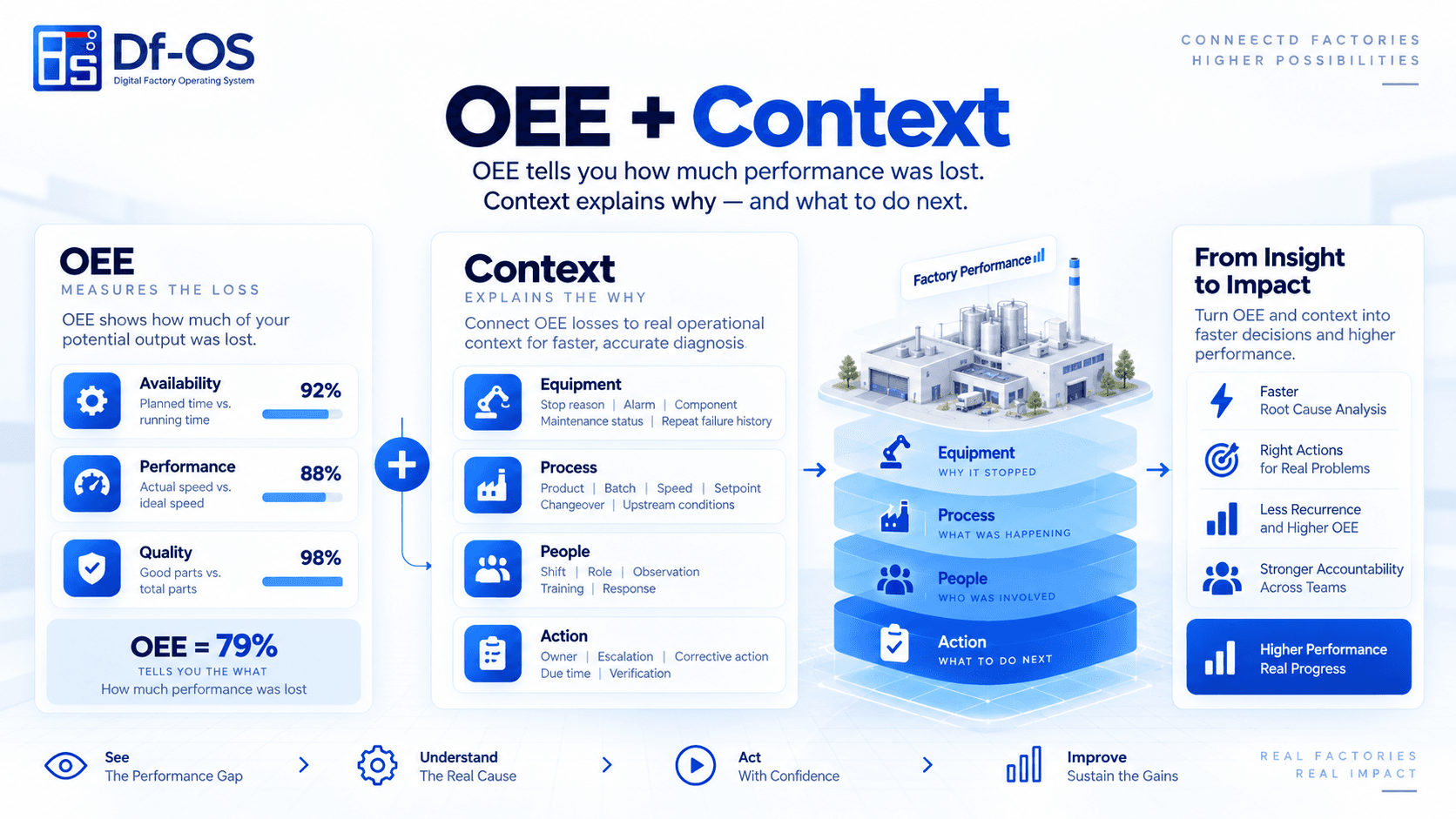
A more useful operating view connects OEE to four layers.
1. Equipment
Stop reason, alarm, component, maintenance status and repeat failure history.
2. Process
Product, batch, speed, setpoint, changeover and upstream conditions.
3. People
Shift, role, observation, training and response.
4. Action
Owner, escalation, corrective action, due time and verification.
This model turns OEE from a score into an improvement system.
Why manual OEE loses detail
When operators enter loss reasons after the shift, short stops may be missed or grouped. The reported OEE may be directionally correct but weak for root cause analysis.
X-Konnect can capture machine state and micro stops automatically. Df-OS can add operator, workflow and decision context. The result becomes part of Factory Metadata & Memory.
How a Factory Control Tower should use OEE
The Control Tower should allow leaders to move from:
- 1. Plant OEE
- 2. Line and shift loss
- 3. Major availability, performance and quality contributors
- 4. Specific events
- 5. Current owner and action
- 6. Similar past history
This path connects management visibility to shopfloor action.
OEE and the Autonomous Factory
Autonomous operations should not optimise a single percentage without understanding the trade-off.
Increasing speed may reduce quality. Reducing downtime may increase maintenance risk. Maximising equipment use may create excess inventory.
The system needs operating context and approved objectives.
Factory Metadata & Memory helps define when a recommendation is appropriate and how the result should be verified.
Questions for an OEE review
- Are loss definitions consistent across lines?
- Are micro stops captured?
- Can each loss be linked to product and shift?
- Are planned and unplanned conditions separated?
- Does the plant see the current owner and action?
- Can repeated losses be compared with previous corrective actions?
- Are improvement decisions based on business impact, not percentage alone?
Final perspective
OEE is an excellent starting point. It is not a complete diagnosis.
The metric shows how much performance was lost. The factory operating system should explain the conditions, ownership and actions behind the loss.
Ready to Modernize Your Factory Operating Layer?
Discover how Df-OS digitizes shopfloor workflows, connects brownfield machines, and creates Factory Metadata & Memory without rip-and-replace disruption.
Frequently Asked Questions
No. They should use OEE with consistent definitions and connected operating context.
Stay Ahead of Manufacturing AI
Join 15,000+ plant managers and industrial leaders receiving our bi-weekly reports on AI agents, shopfloor data operations, and the future of smart factories.
Df-OS Editorial Board
Industry experts mapping the future of connected digital factory operating systems and manufacturing intelligence.
Related Insights & Guides
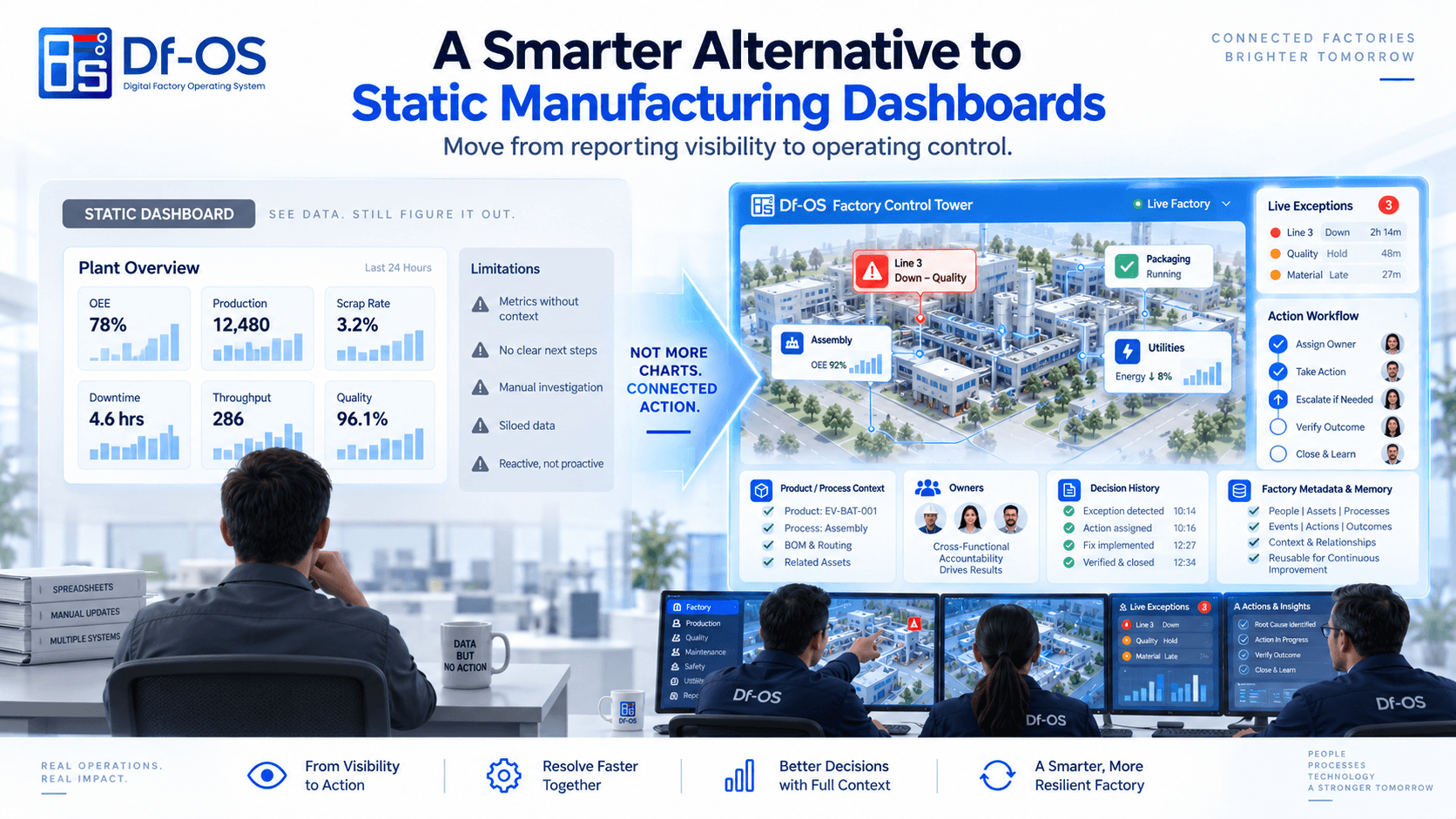
A Smarter Alternative to Static Manufacturing Dashboards
A comparison of static manufacturing dashboards and a connected Factory Control Tower that links metrics to live events, context, owners, workflows, escalation and verified closure.
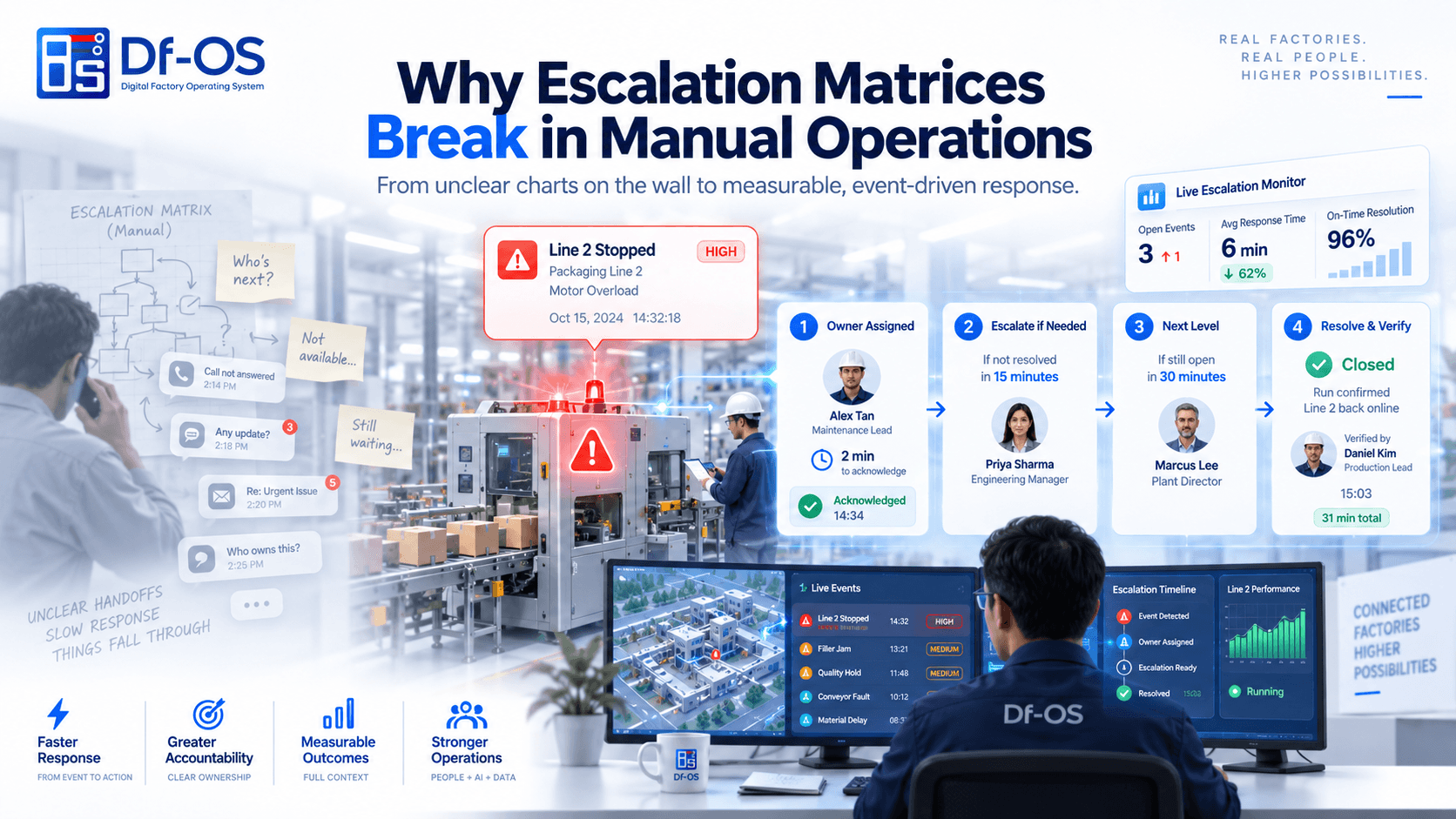
Why Escalation Matrices Break in Manual Operations
Why manual factory escalation matrices fail and how event-driven workflows connect measurable triggers, ownership, response time, escalation, closure evidence and learning.
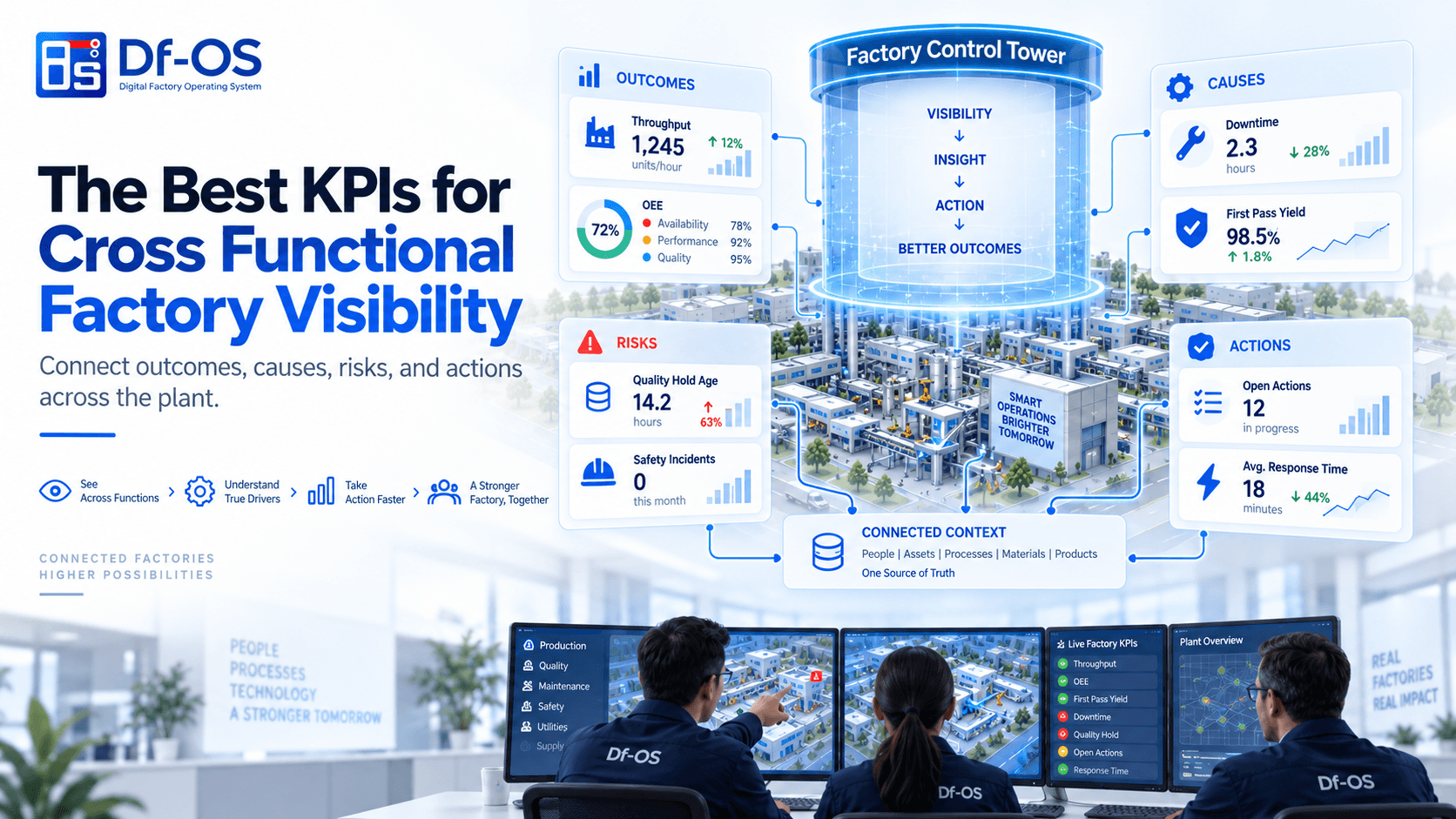
The Best KPIs for Cross Functional Factory Visibility
A four-level KPI framework connecting plant outcomes, operating causes, forward risks and action closure across production, quality, maintenance, safety and utilities.