
Why Escalation Matrices Break in Manual Operations
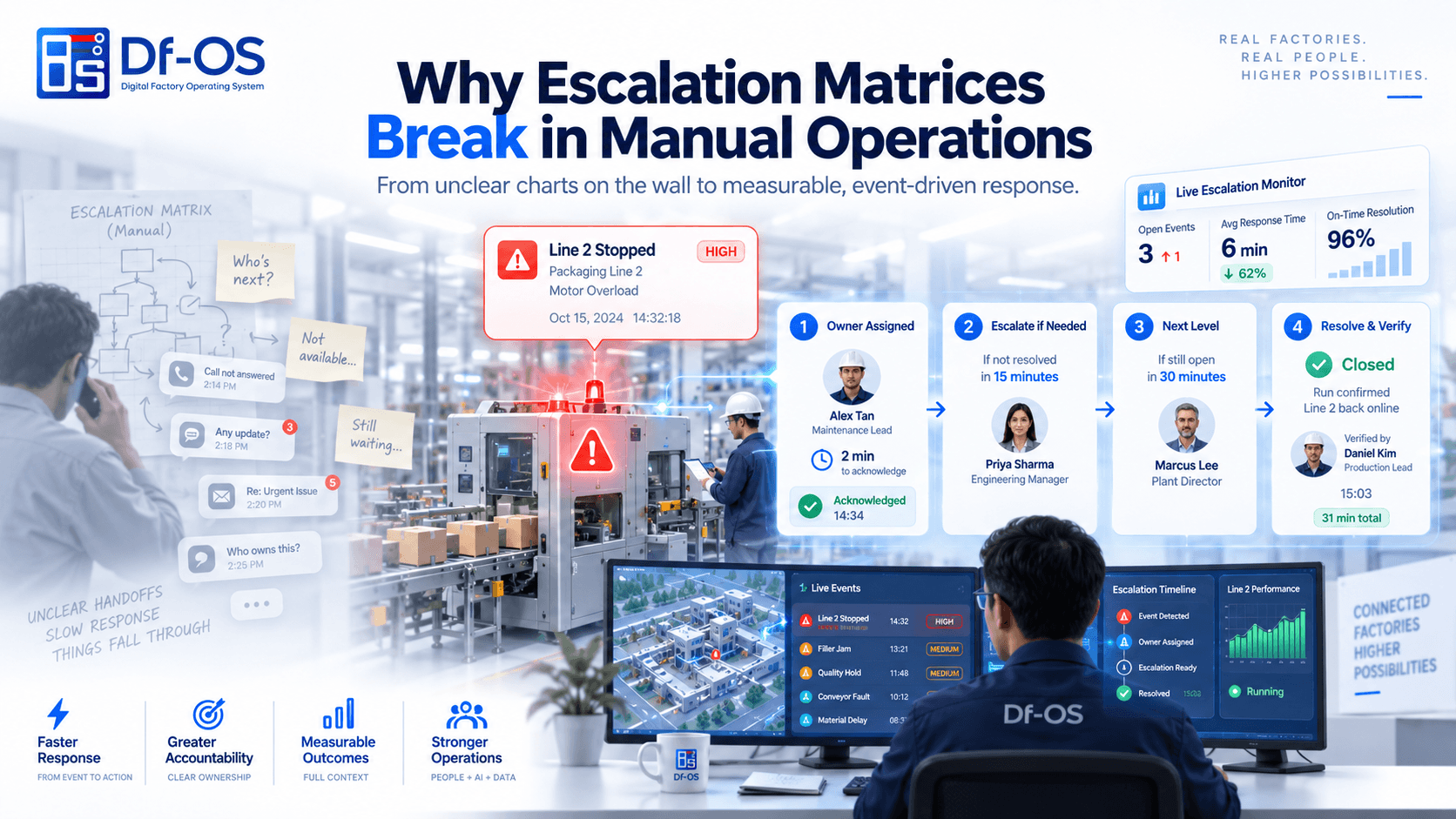
Manual escalation matrices break because events are detected late, ownership is unclear, response time is not measured and closure is not connected to the original issue. A digital escalation workflow needs a defined trigger, owner, time limit, escalation level, evidence and verified closure.
Most factories have an escalation matrix.
The chart identifies who should be informed when a problem crosses a threshold. Yet the same issues are still escalated late, followed up repeatedly and closed without clear evidence.
The chart is rarely the main problem.
The process fails because detection, ownership, timing and closure remain informal.
The six points where escalation breaks
1. The trigger is unclear
Terms such as major issue or prolonged downtime leave room for interpretation.
A digital workflow needs a measurable trigger based on severity, duration, risk or business impact.
2. Detection is late
If the event is recorded after the shift, the escalation begins after the action window.
Machine connectivity and real time workflows reduce this delay.
3. Ownership is assumed
A message sent to a group is not the same as an assigned action.
The system should identify one responsible role and show acknowledgement.
4. Response time is not measured
The factory may know the issue was escalated but not how long each level took to respond.
5. Closure is weak
A verbal confirmation or message may end the follow-up without evidence that the risk was removed.
6. The factory does not learn
The escalation record is not connected to recurrence, corrective action or similar events.
The six elements of a digital escalation workflow
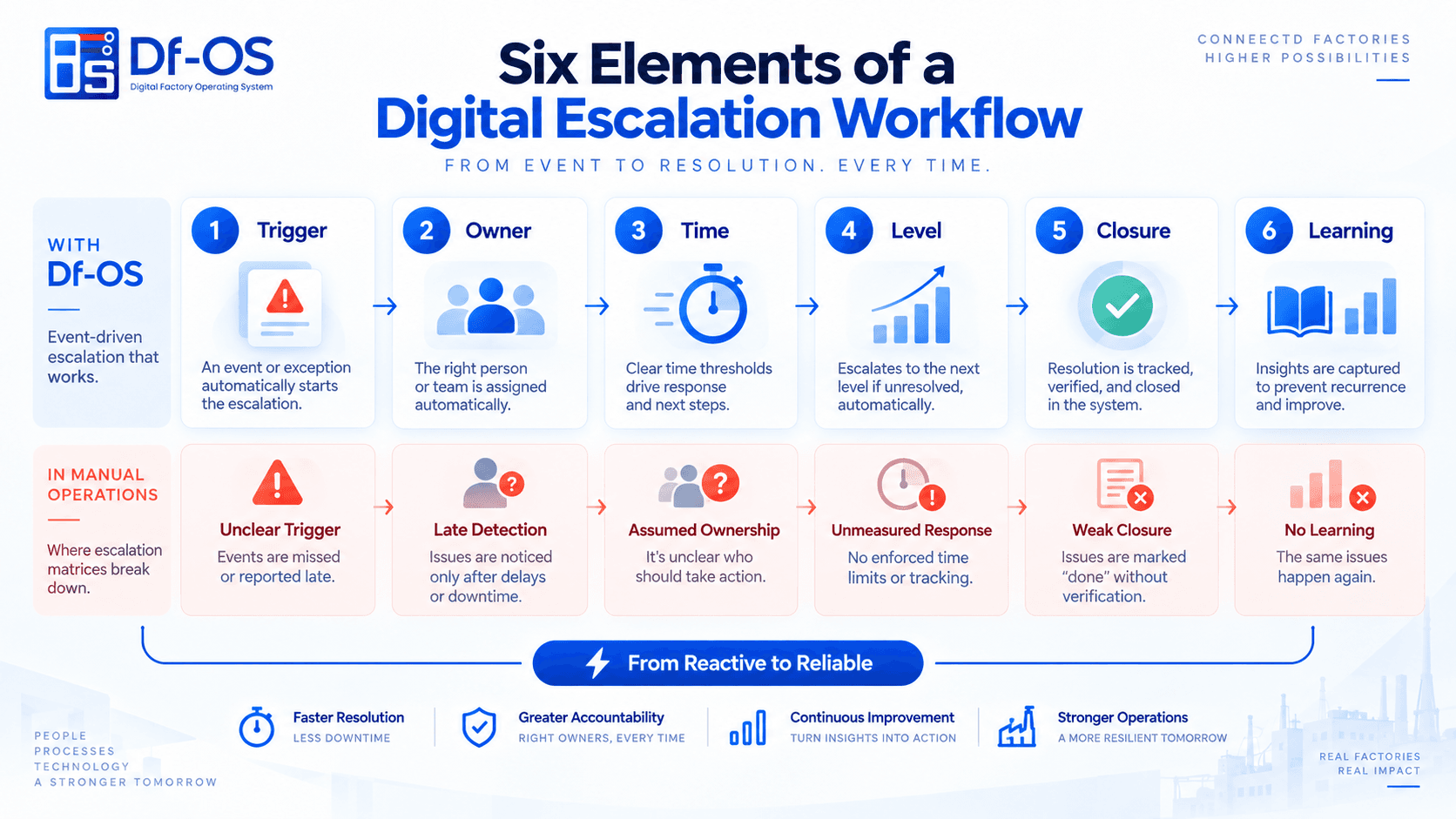
- 1. Trigger: the condition that starts the escalation
- 2. Owner: the role responsible for response
- 3. Time: expected acknowledgement and action window
- 4. Level: the next role when the condition remains unresolved
- 5. Closure: the evidence and approval required
- 6. Learning: the link to cause, corrective action and recurrence
A simple downtime example
A critical machine stops.
In a manual process, the operator calls the supervisor. The supervisor messages maintenance. After twenty minutes, the plant head is informed. No one can see whether the technician acknowledged the issue or what condition caused the delay.
In an event driven process:
- X-Konnect detects the stop
- Df-OS creates the downtime event
- The responsible technician receives the task
- The response timer begins
- The next level is notified when the time limit is crossed
- The Factory Control Tower shows status and ownership
- Closure requires action and verification
- The event becomes part of Factory Metadata & Memory
The matrix becomes an operating process.
Escalation should match risk
Not every issue needs the same path.
The workflow should consider:
- Safety risk
- Quality risk
- Production impact
- Asset criticality
- Customer impact
- Regulatory requirement
- Duration
- Recurrence
This prevents both under escalation and alert fatigue.
Human accountability remains essential
Automation can route and time the escalation. It cannot replace accountability.
The organisation must define:
- Who owns the event
- Who can approve temporary conditions
- Who can close the issue
- Who can change the escalation rule
- Who reviews repeat failure
How Vish AI can help
Vish AI can summarise active escalations, identify repeated patterns and highlight open actions that threaten the current plan.
It can support attention. It should not create an ungoverned escalation rule.
An escalation audit
Review one high impact process and ask:
- Is the trigger measurable?
- Is one owner assigned?
- Is acknowledgement visible?
- Are response times defined?
- Does the workflow escalate automatically?
- Is closure evidence required?
- Can repeat escalations be analysed?
- Is the history preserved?
Final perspective
An escalation matrix is useful only when it changes behaviour in time.
Connect the trigger to ownership, timing, closure and learning. Then the matrix stops being a chart on the wall and becomes part of the factory operating system.
Ready to Modernize Your Factory Operating Layer?
Discover how Df-OS digitizes shopfloor workflows, connects brownfield machines, and creates Factory Metadata & Memory without rip-and-replace disruption.
Frequently Asked Questions
No. Alerts should be prioritised by risk and action requirement. Too many escalations reduce attention.
Stay Ahead of Manufacturing AI
Join 15,000+ plant managers and industrial leaders receiving our bi-weekly reports on AI agents, shopfloor data operations, and the future of smart factories.
Df-OS Editorial Board
Industry experts mapping the future of connected digital factory operating systems and manufacturing intelligence.
Related Insights & Guides
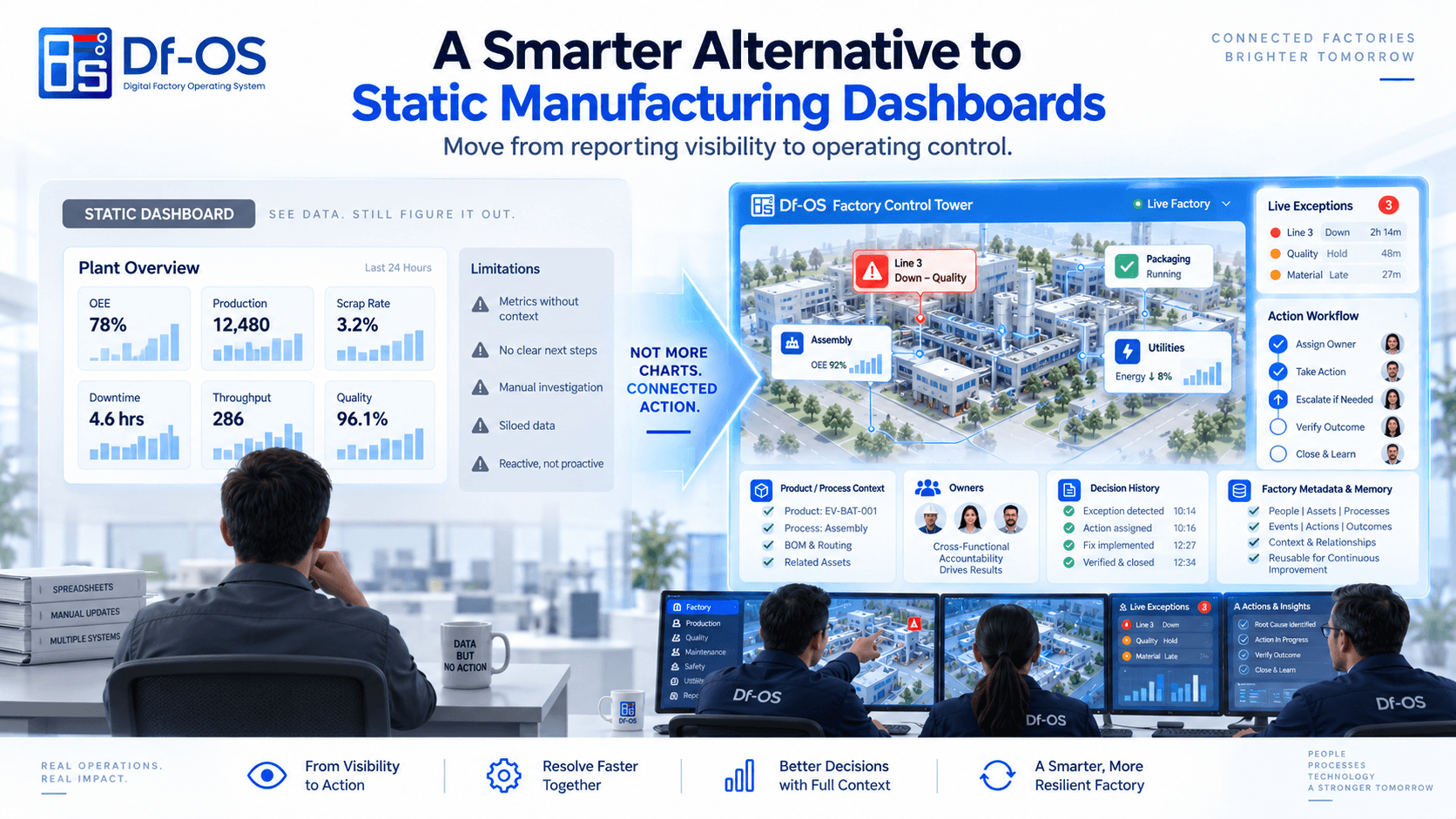
A Smarter Alternative to Static Manufacturing Dashboards
A comparison of static manufacturing dashboards and a connected Factory Control Tower that links metrics to live events, context, owners, workflows, escalation and verified closure.
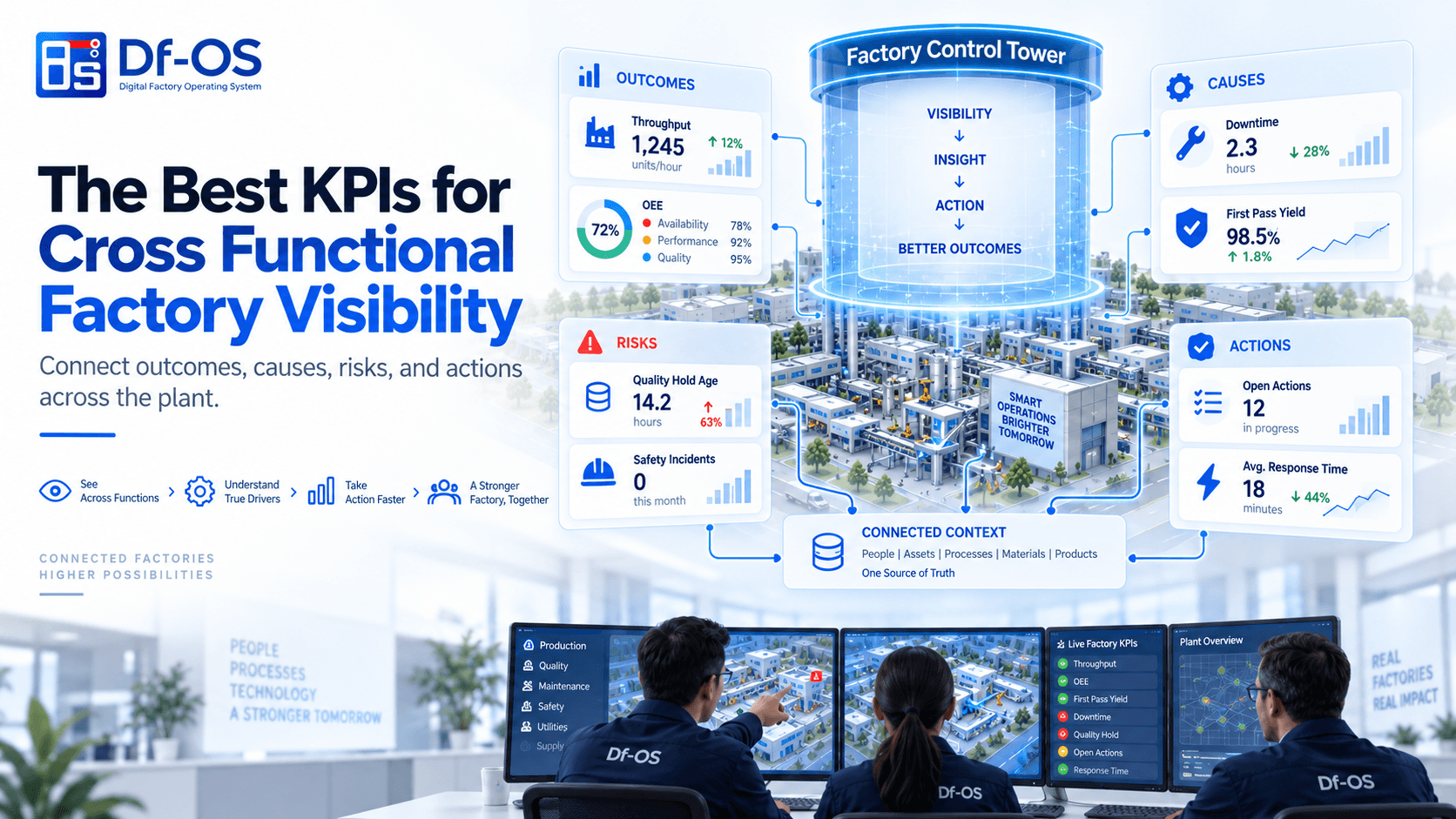
The Best KPIs for Cross Functional Factory Visibility
A four-level KPI framework connecting plant outcomes, operating causes, forward risks and action closure across production, quality, maintenance, safety and utilities.
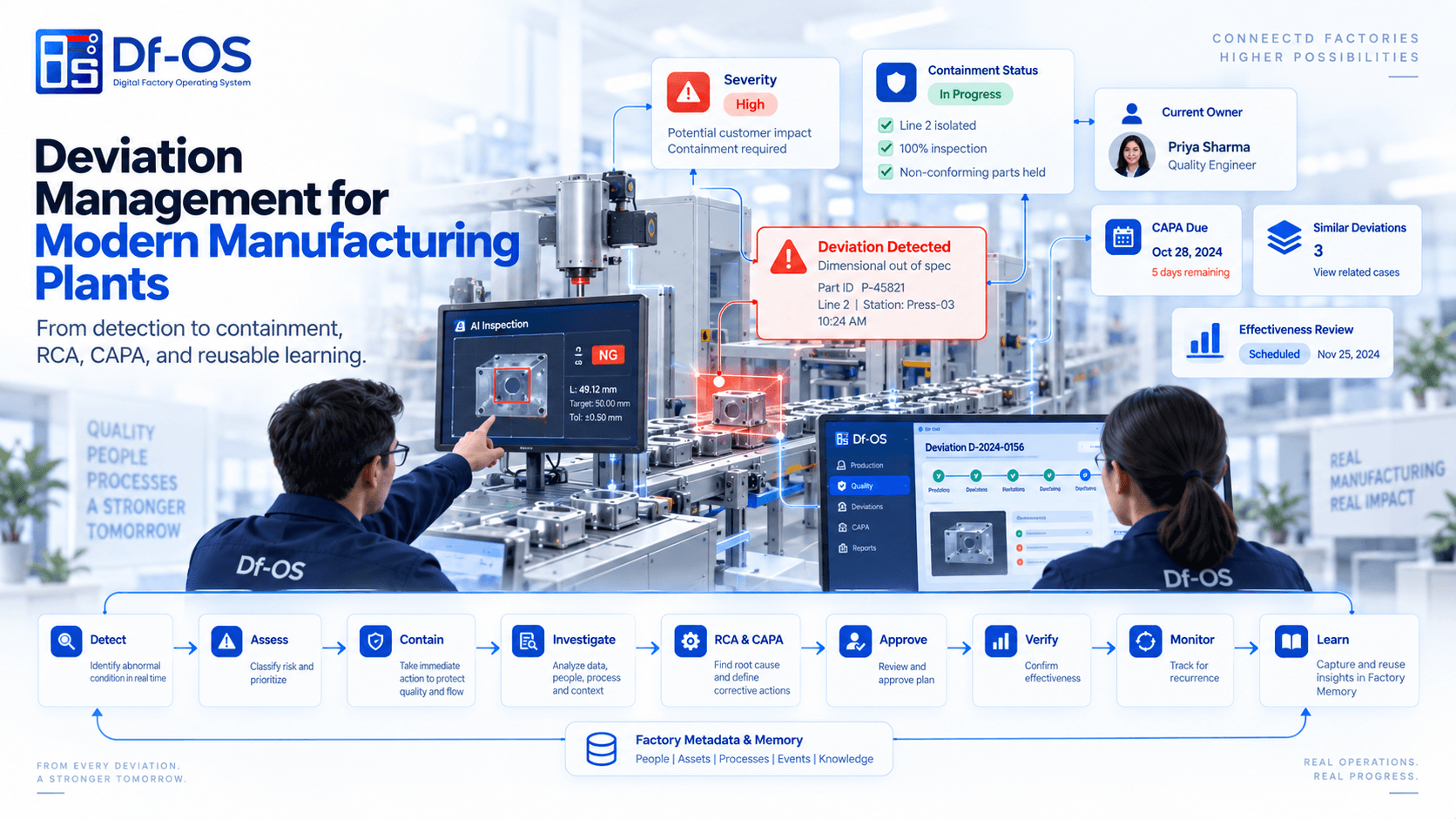
Deviation Management for Modern Manufacturing Plants
A connected manufacturing deviation lifecycle from detection and containment through RCA, CAPA, effectiveness review, recurrence monitoring and reusable operating memory.