
How to Run Daily Factory Reviews Without Chasing Data
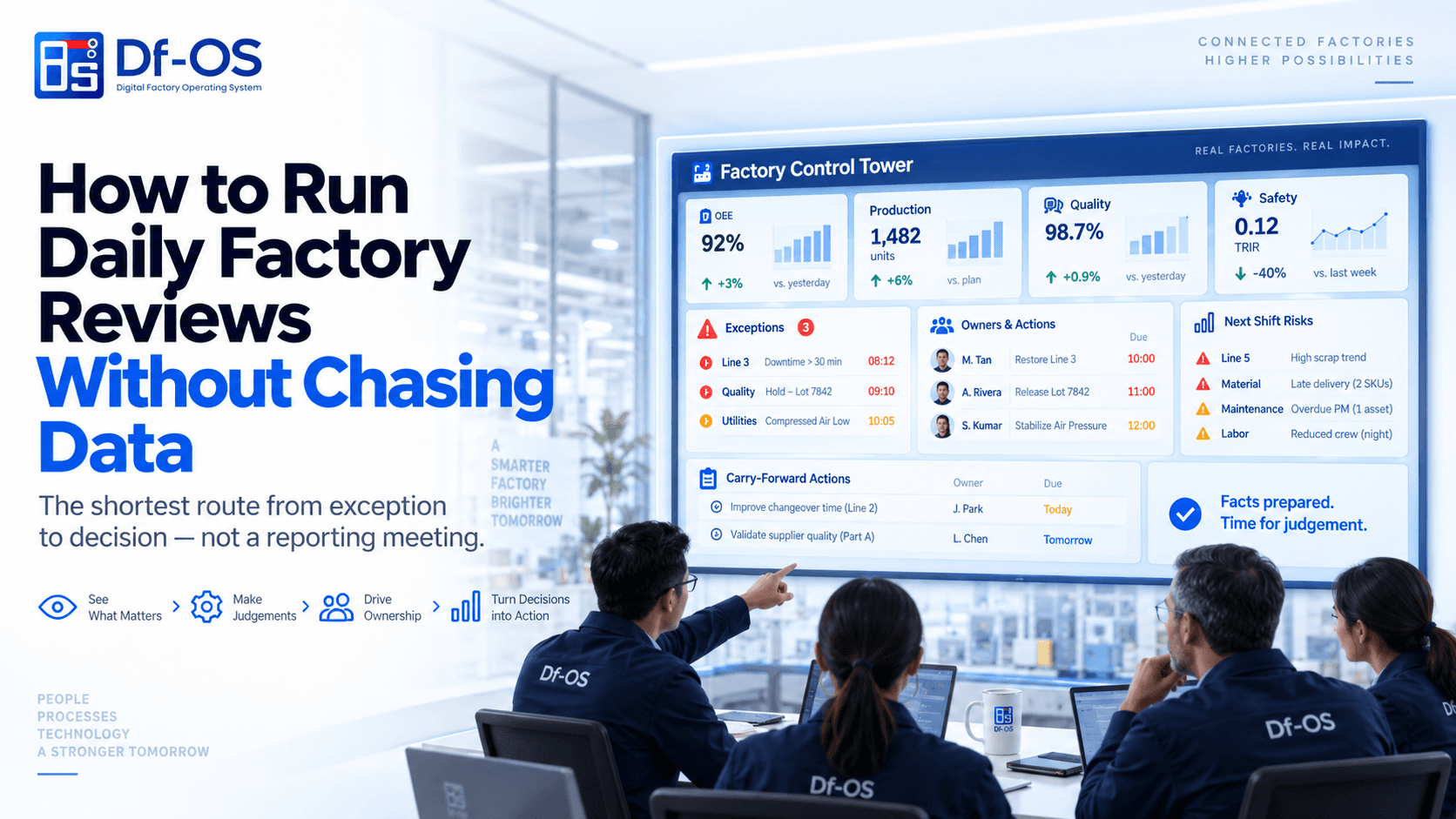
An effective daily factory review uses one trusted operating view, focuses on exceptions, connects metrics to causes and owners, records decisions and carries unresolved actions into the next cycle. Data collection should happen before the meeting through connected workflows and systems.
A daily factory review should not be a reporting meeting.
It should be the plant's shortest route from exception to decision.
Yet many reviews begin with supervisors assembling spreadsheets, reconciling numbers and explaining why different reports do not match. The meeting spends time discovering the problem instead of resolving it.
A connected daily review changes the sequence. The operating system prepares the facts. The team uses the meeting for judgement, ownership and action.
What the review is meant to do
A useful daily review should:
- Confirm the current operating state
- Identify the most important losses and risks
- Understand the cause or missing information
- Assign decisions and actions
- Escalate what the plant cannot resolve
- Verify closure from the previous review
If the meeting does not change action, it is only a presentation.
The common failure modes
Too many metrics
A large scorecard can hide the few issues that require attention.
Data prepared manually
The review begins with old information and consumes supervisor time before the meeting.
No connection to cause
The team sees that OEE or output fell but must search for the events behind the number.
Actions without ownership
Minutes record the discussion, but due time, escalation and closure remain unclear.
The same issue returns
The plant closes the meeting but does not preserve the decision and result as Factory Metadata & Memory.
A 30 minute daily review model
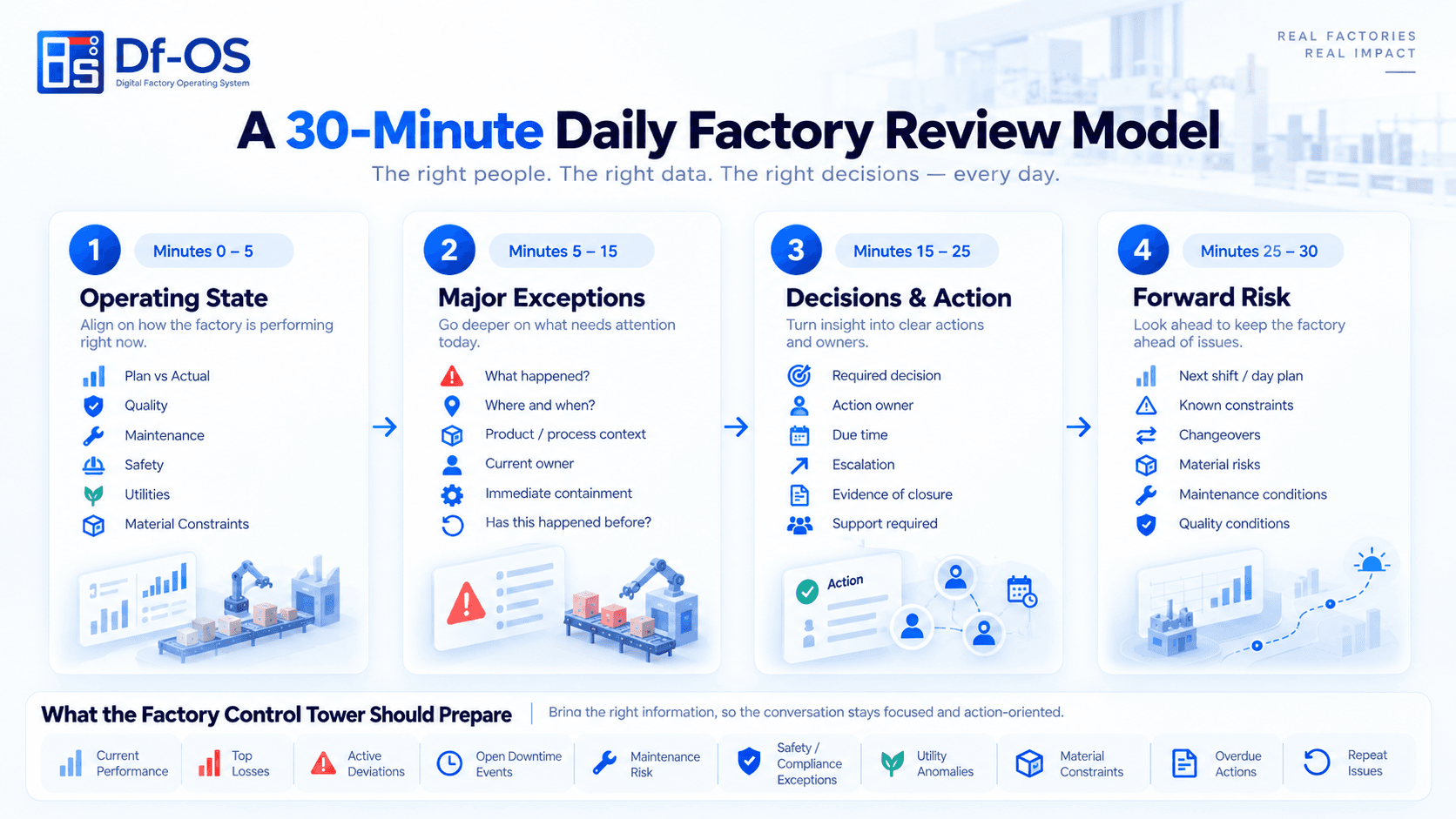
Minutes 0 to 5: operating state
Review plan versus actual, quality, maintenance, safety, utilities and material constraints.
Use one trusted view. Do not debate every number unless the variance affects a decision.
Minutes 5 to 15: major exceptions
Focus on the few events with the greatest impact or risk.
For each exception, show:
- What happened
- Where and when
- Product and process context
- Current owner
- Immediate containment or response
- Whether the issue has happened before
Minutes 15 to 25: decisions and action
Confirm:
- Required decision
- Action owner
- Due time
- Escalation
- Evidence of closure
- Support required from another function
Minutes 25 to 30: forward risk
Review the next shift or day's plan for known constraints, changeovers, material risks, maintenance and quality conditions.
The meeting should end with a shared view of what could affect the next operating period.
What the Factory Control Tower should prepare
The Control Tower should compile:
- Current performance and plan
- Top losses
- Active deviations
- Open downtime events
- Maintenance risk
- Safety and compliance exceptions
- Utility anomalies
- Material constraints
- Overdue actions
- Repeat issues
Users should be able to move from the summary to the event and action history.
The role of Factory Metadata & Memory
A daily review becomes more valuable when it can compare the present with the past.
The team should be able to see:
- Whether the issue repeated
- What action was used before
- Whether the previous action worked
- Which plant or line has seen a similar event
- Which decisions remain open
This prevents the meeting from treating recurring problems as new.
How Vish AI can support the review
Vish AI can prepare a concise summary of:
- Largest deviations from plan
- Repeated downtime patterns
- Open quality risks
- Actions overdue by owner
- Conditions likely to affect the next shift
The summary should link back to the underlying records. The leadership team remains responsible for prioritisation and decision.
Meeting discipline still matters
Technology cannot fix a review with unclear purpose.
The plant should define:
- One meeting owner
- Required participants
- Decision rights
- Standard agenda
- Time limit
- Escalation path
- Closure rule
The Control Tower supports this discipline. It does not replace it.
A review quality checklist
- Does the meeting begin with current information?
- Are exceptions prioritised by impact and risk?
- Can the team see the cause and owner behind a metric?
- Are previous actions reviewed before new actions are added?
- Does every action have a due time?
- Are unresolved issues escalated?
- Is the next operating risk discussed?
- Is the decision history preserved?
The Df-OS approach
Df-OS connects production, quality, maintenance, safety and utility workflows. X-Konnect adds machine context. The Factory Control Tower prepares the live operating view. Factory Metadata & Memory preserves the decision and closure history. Vish AI can support summaries and pattern recognition.
Final perspective
A daily factory review should convert operating reality into coordinated action.
When leaders stop chasing data, they can spend the meeting on the work only people can do: judgement, trade-offs, ownership and improvement.
Ready to Modernize Your Factory Operating Layer?
Discover how Df-OS digitizes shopfloor workflows, connects brownfield machines, and creates Factory Metadata & Memory without rip-and-replace disruption.
Frequently Asked Questions
Only enough to show the current operating state and reveal important exceptions. Detailed analysis can sit below the main view.
Stay Ahead of Manufacturing AI
Join 15,000+ plant managers and industrial leaders receiving our bi-weekly reports on AI agents, shopfloor data operations, and the future of smart factories.
Df-OS Editorial Board
Industry experts mapping the future of connected digital factory operating systems and manufacturing intelligence.
Related Insights & Guides
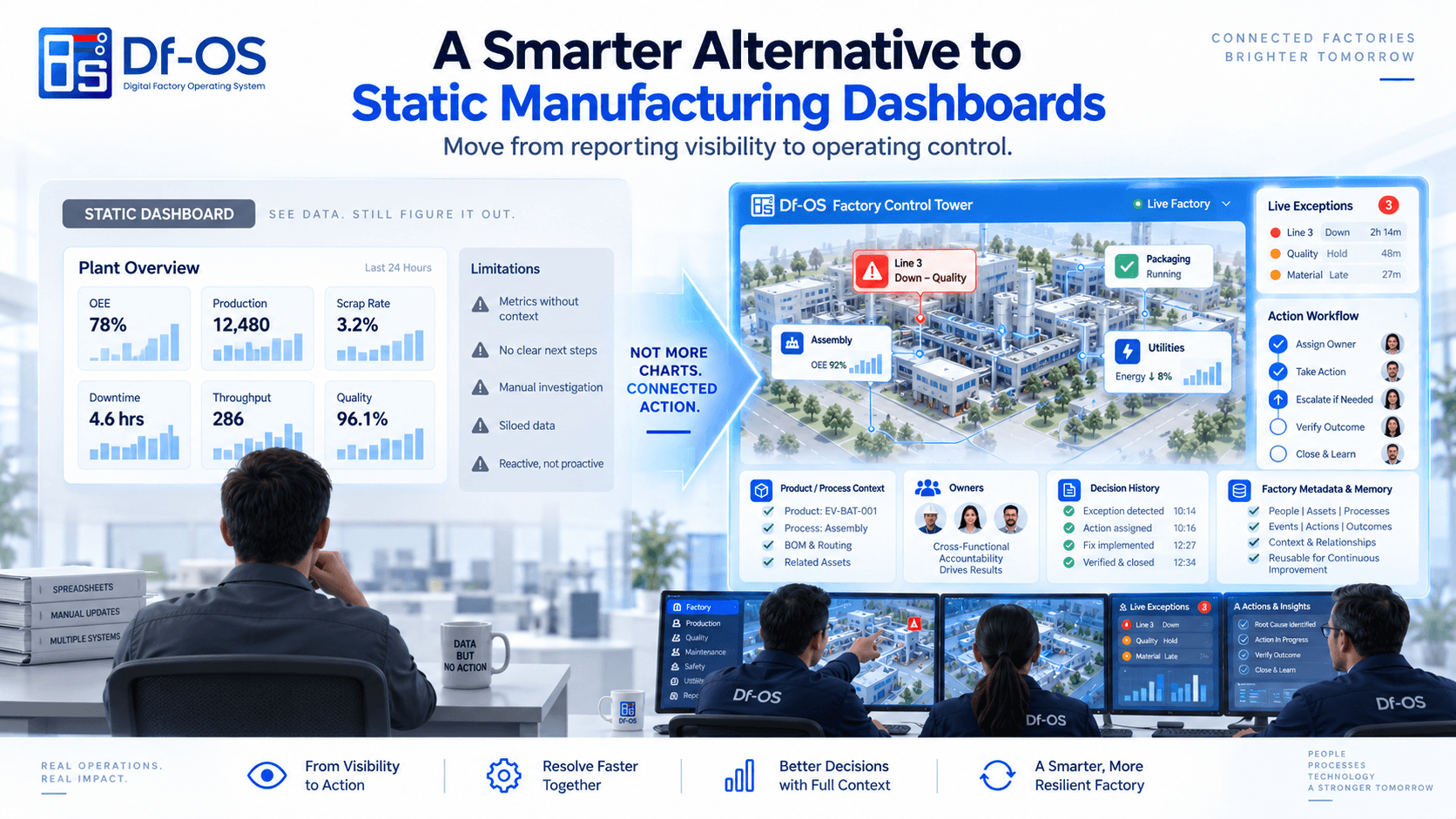
A Smarter Alternative to Static Manufacturing Dashboards
A comparison of static manufacturing dashboards and a connected Factory Control Tower that links metrics to live events, context, owners, workflows, escalation and verified closure.
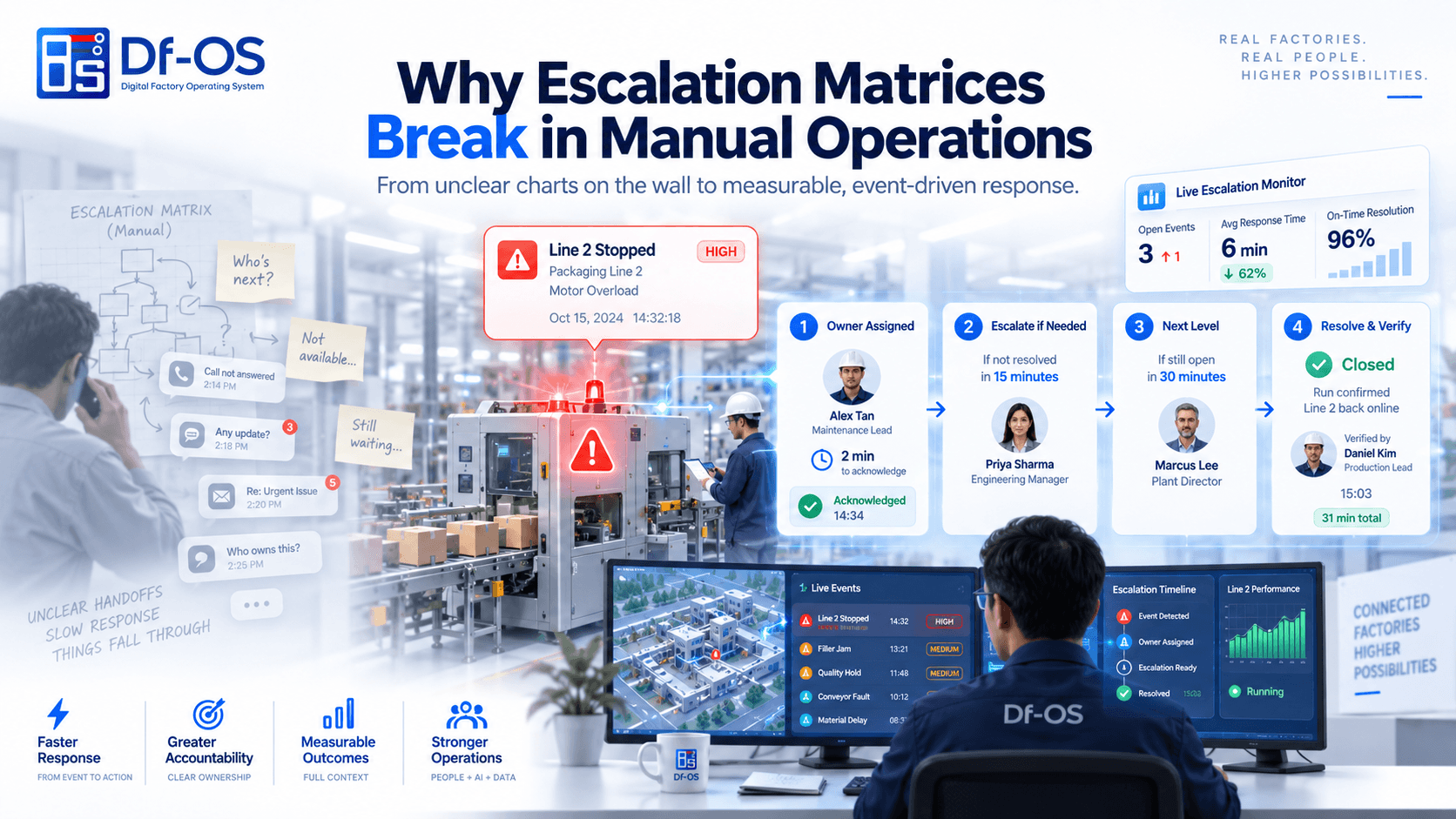
Why Escalation Matrices Break in Manual Operations
Why manual factory escalation matrices fail and how event-driven workflows connect measurable triggers, ownership, response time, escalation, closure evidence and learning.
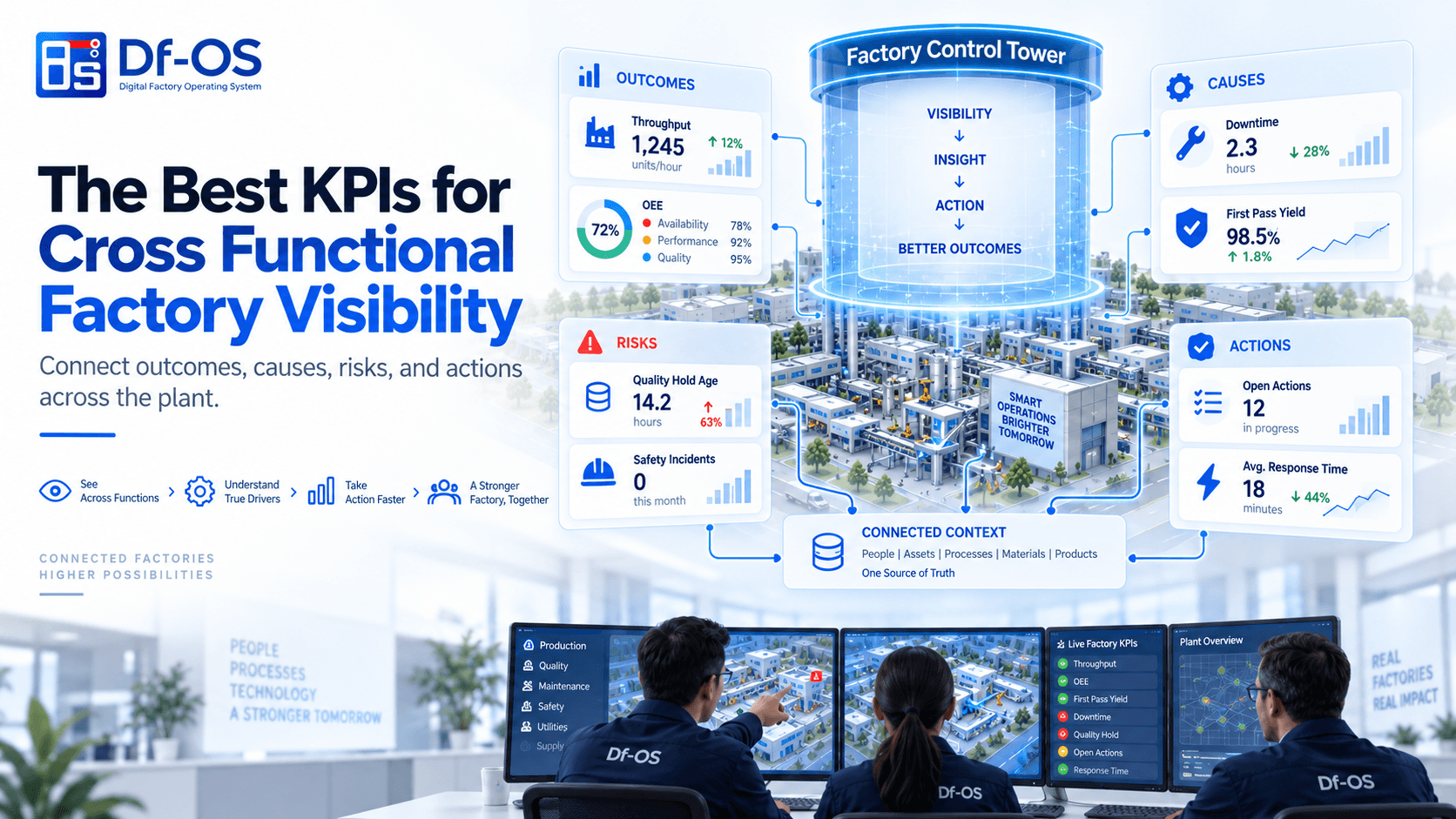
The Best KPIs for Cross Functional Factory Visibility
A four-level KPI framework connecting plant outcomes, operating causes, forward risks and action closure across production, quality, maintenance, safety and utilities.