
Factory Metadata & Memory: The Operating Context Behind Industrial Autonomy
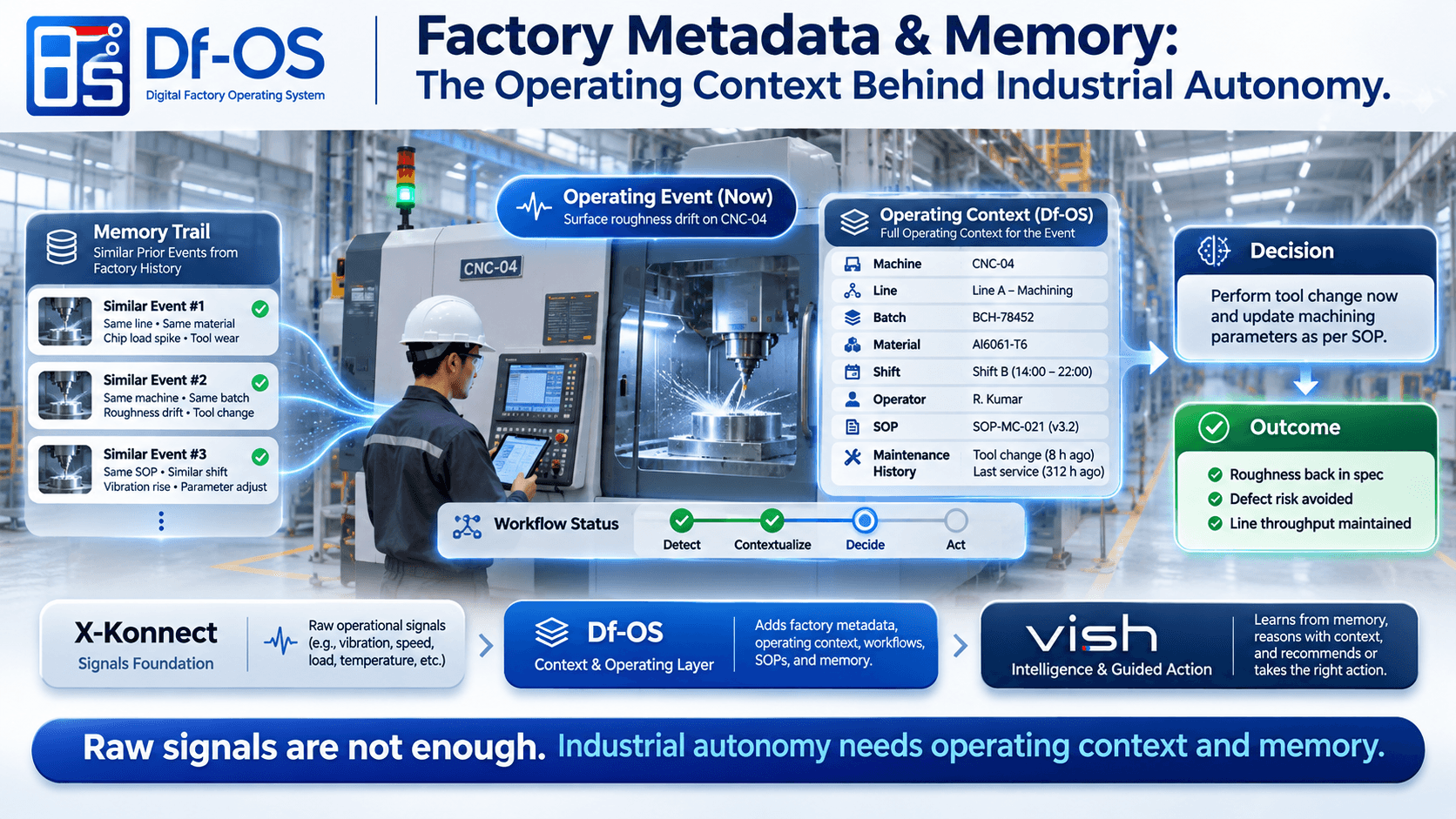
Factory Metadata & Memory is the operating context layer that connects factory events to identity, conditions, people, workflows, decisions and outcomes. Metadata explains the relationships around an event; memory preserves sequence, intervention and result. Together they provide the traceable evidence needed for reliable decision support, guided action and bounded industrial autonomy.
A factory cannot make dependable decisions from signals it does not understand. A rise in motor current, a missed inspection or a failed final test each means something different depending on the product, operating step, equipment condition and previous interventions. That surrounding information is the difference between observing a problem and knowing how to respond to it.
Factory Metadata & Memory provides this context. Metadata describes the relationships around an event. Memory preserves its sequence, the decisions made and the outcome. Together, they make it possible to move from reporting factory events to supporting repeatable, accountable decisions. This is especially important when manufacturers want to progress toward an Autonomous Factory.
The difference between a data point and an operating fact
Consider a temperature reading of 83 degrees Celsius. On its own, it is simply a value. It becomes useful only when connected to the correct asset, sensor calibration, process step, material, product specification, timestamp and operating limit.
Suppose that reading appeared during a changeover. The factory also needs to know the work instruction in force, whether an operator had signed off the setup, whether a maintenance alert was open and which previous deviations followed similar conditions. A system that can connect those records has a much stronger basis for recommending action.
Manufacturers have invested heavily in collecting data. Data collection is necessary, but it does not automatically produce shared understanding. Historians, MES, ERP, laboratory systems and spreadsheets each preserve fragments of operating reality. Factory Metadata & Memory gives these fragments common relationships.
Four categories of context an autonomous operation needs
Identity and location
Every relevant event should be linked to the asset, line, process step, product, batch, material lot or serialized unit concerned. Consistent identifiers matter more than elaborate visualisations. If two systems call the same machine by different names, the factory can lose the relationship that explains an event.
Operating conditions
Machine parameters, environmental conditions, planned settings and process limits describe what was happening. A value should be interpreted against the specification that applied at that moment, not simply today's default threshold.
People and workflow
Production is organised through responsibilities. A deviation belongs to a shift, a role, an approval route and a corrective action. The system should retain the instruction, task status and reviewer decision, including when the issue was escalated.
Outcomes and history
The most valuable record often comes after the event: what was changed, whether the defect returned and whether the corrective action was verified. Without this memory, the same investigation starts again at the next occurrence.
These categories reflect the familiar 4M approach of Man, Machine, Material and Method, extended through time, workflow and decision history.
Why metadata and memory must stay together
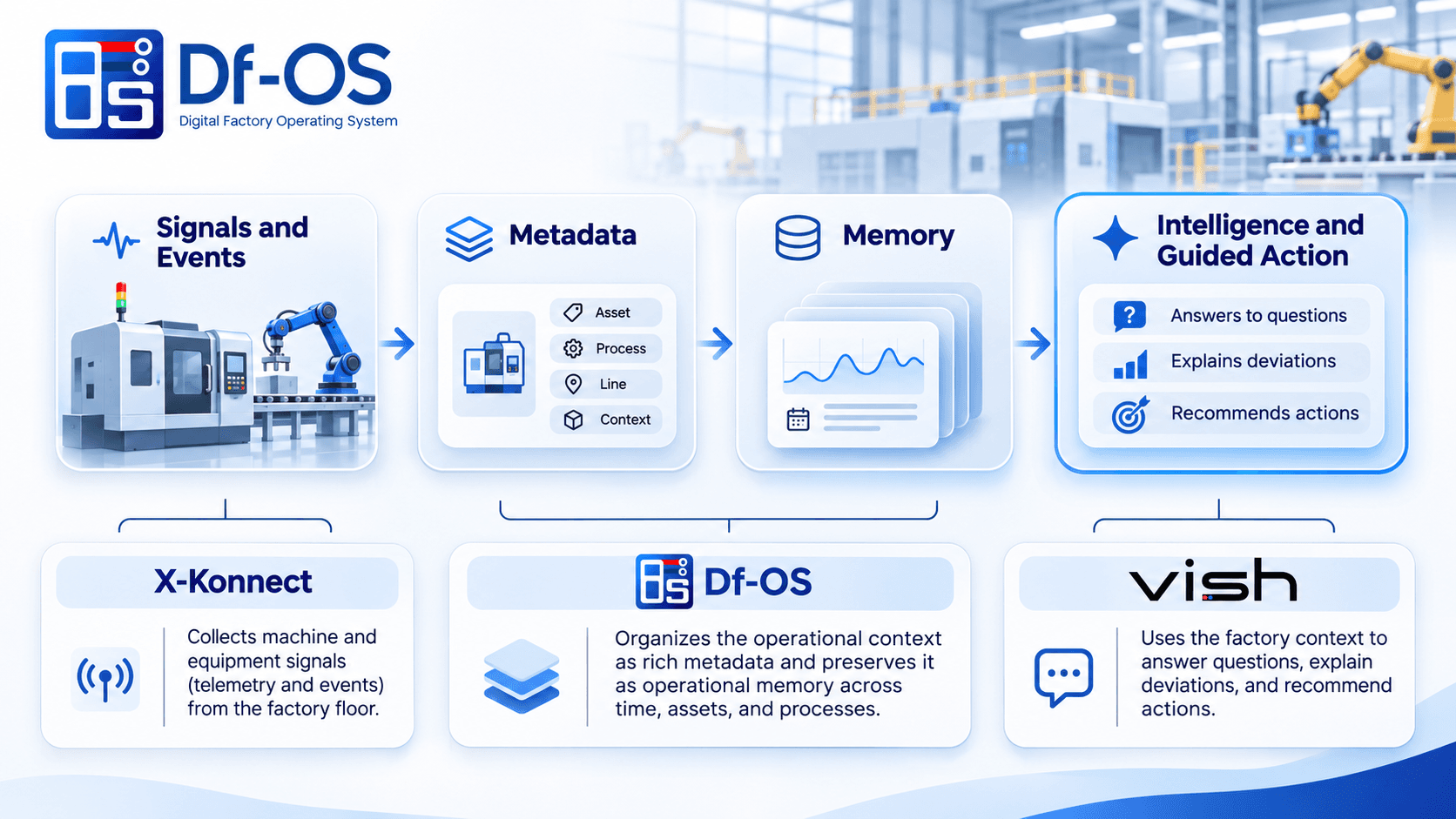
Metadata without memory describes isolated relationships. Memory without metadata produces a collection of records that may be difficult to interpret or compare.
A maintenance ticket stating "bearing issue resolved" is a weak historical record. It becomes stronger when associated with the exact asset, fault signature, production load, component batch, repair action, elapsed time and follow-up inspection. The next engineer can judge whether a new incident resembles the earlier one and whether the same remedy applies.
This is the practical value of connected context. The purpose is not to claim that a database thinks like a person. It is to preserve enough operating evidence for people and industrial intelligence systems to make better judgements.
What changes for quality, maintenance and production
In quality, connected genealogy can establish the material lots, machine settings, operators, process checks and rework history associated with a failed unit. A quality manager can then investigate the affected population rather than examine unrelated production.
In maintenance, an alarm is linked to machine load, previous failure codes, preventive maintenance history and the actual corrective task. Repeat patterns become easier to identify and discuss.
In production, shift handovers preserve open constraints, deviations, approvals and decisions. When the next shift begins, the operating context does not disappear with the outgoing team.
Each example reduces the gap between knowing something happened and knowing what to do about it.
The autonomy test: can the evidence support the proposed action?
Before moving any decision toward guided or automatic execution, an engineering and operations team should test five conditions.
- Can the event be identified reliably, including its source and timing?
- Is the applicable process specification or rule known?
- Are relevant exceptions, approvals and prior actions accessible?
- Can the system explain why a particular response is being suggested?
- Can the result be verified and the action reversed or escalated when necessary?
If answers are incomplete, the appropriate maturity step may be improved data capture or decision support, not automatic execution. This prevents industrial autonomy from becoming an exercise in unwarranted confidence.
A manufacturing architecture built around operating context
An effective design does not need to copy every record into one giant repository. It needs a trustworthy way to connect identifiers, events, permissions and evidence across systems. Machine and sensor data remain governed by OT requirements. Business and product records maintain their own system responsibilities. The operating layer connects those records to workflows and maintains an auditable history.
Df-OS digitises daily execution, while X-Konnect connects suitable machine signals and industrial data sources. Together, these inputs help form Factory Metadata & Memory. Vish AI can then use the connected context to answer operational questions, investigate deviations and recommend actions, with human oversight.
The boundary is important. The existence of a knowledge graph or a conversational interface is not proof that a factory has safe autonomous control. Autonomy requires validated decision rules, ownership, access controls, intervention paths and outcome verification.
Begin with one event family
A practical programme can start with recurring downtime, failed quality tests or delayed inspection closure. Choose one event family and define its standard identifiers, essential context, workflow states and outcome records. Check data completeness weekly. Ask whether a supervisor unfamiliar with the original incident can reconstruct the decision from the system.
Once the record supports that reconstruction, the plant has a useful foundation for decision support. Additional machine types, products and workflows can be added without sacrificing meaning.
This is how Factory Metadata & Memory becomes operational infrastructure rather than a branding phrase. It preserves the evidence that allows a factory to learn and gives bounded autonomous operations a defensible basis.
Ready to Modernize Your Factory Operating Layer?
Discover how Df-OS digitizes shopfloor workflows, connects brownfield machines, and creates Factory Metadata & Memory without rip-and-replace disruption.
Frequently Asked Questions
No. A data lake can store large volumes of information. Factory Metadata & Memory emphasises the relationships, workflow events, decisions and outcomes needed to interpret operating history.
Stay Ahead of Manufacturing AI
Join 15,000+ plant managers and industrial leaders receiving our bi-weekly reports on AI agents, shopfloor data operations, and the future of smart factories.
Df-OS Editorial Board
Industry experts mapping the future of connected digital factory operating systems and manufacturing intelligence.
Related Insights & Guides
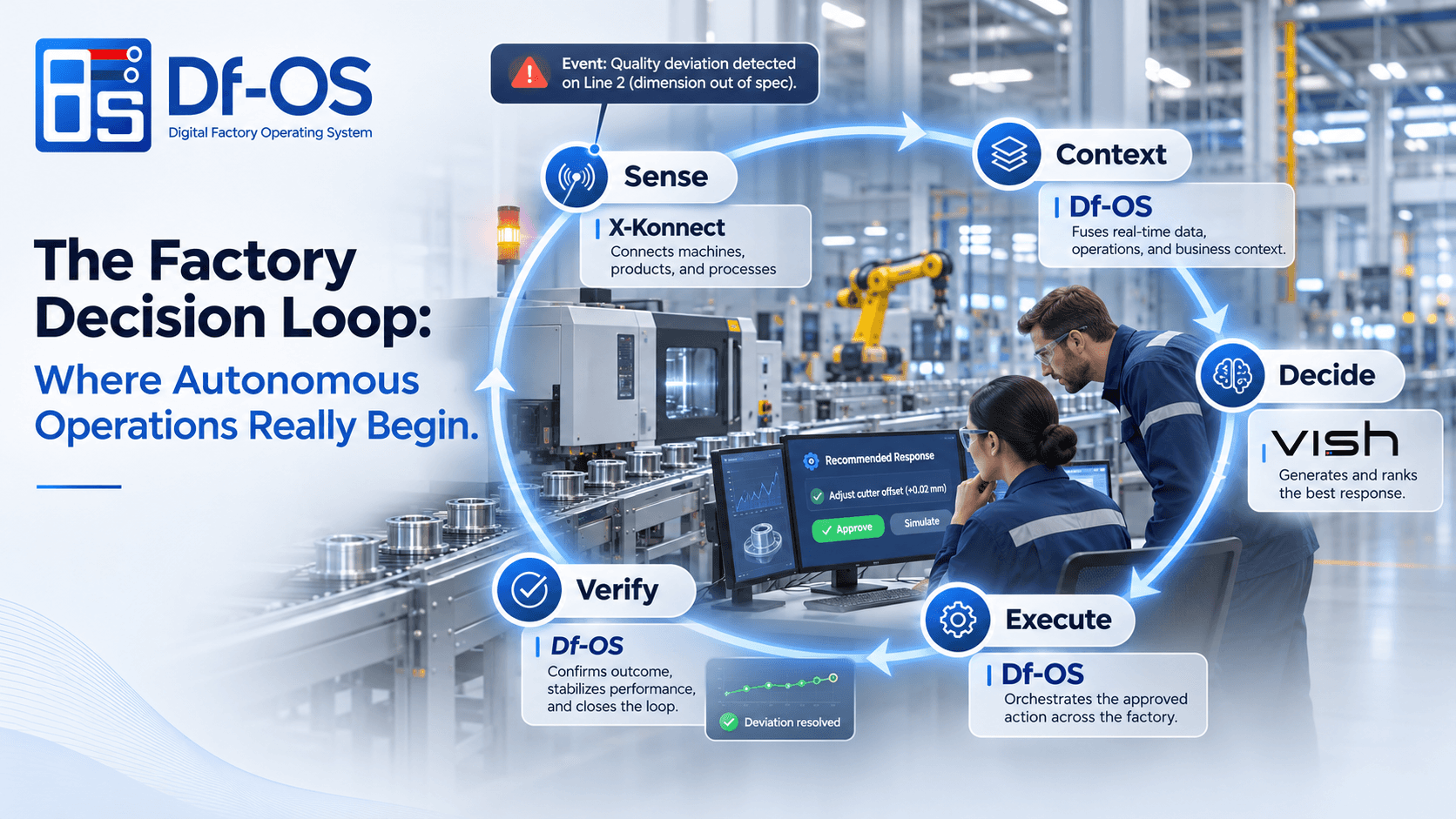
The Factory Decision Loop: Where Autonomous Operations Really Begin
Autonomous operations begin by making recurring factory decision loops dependable: detect the event, establish context, apply the authorised response, execute and verify the outcome.
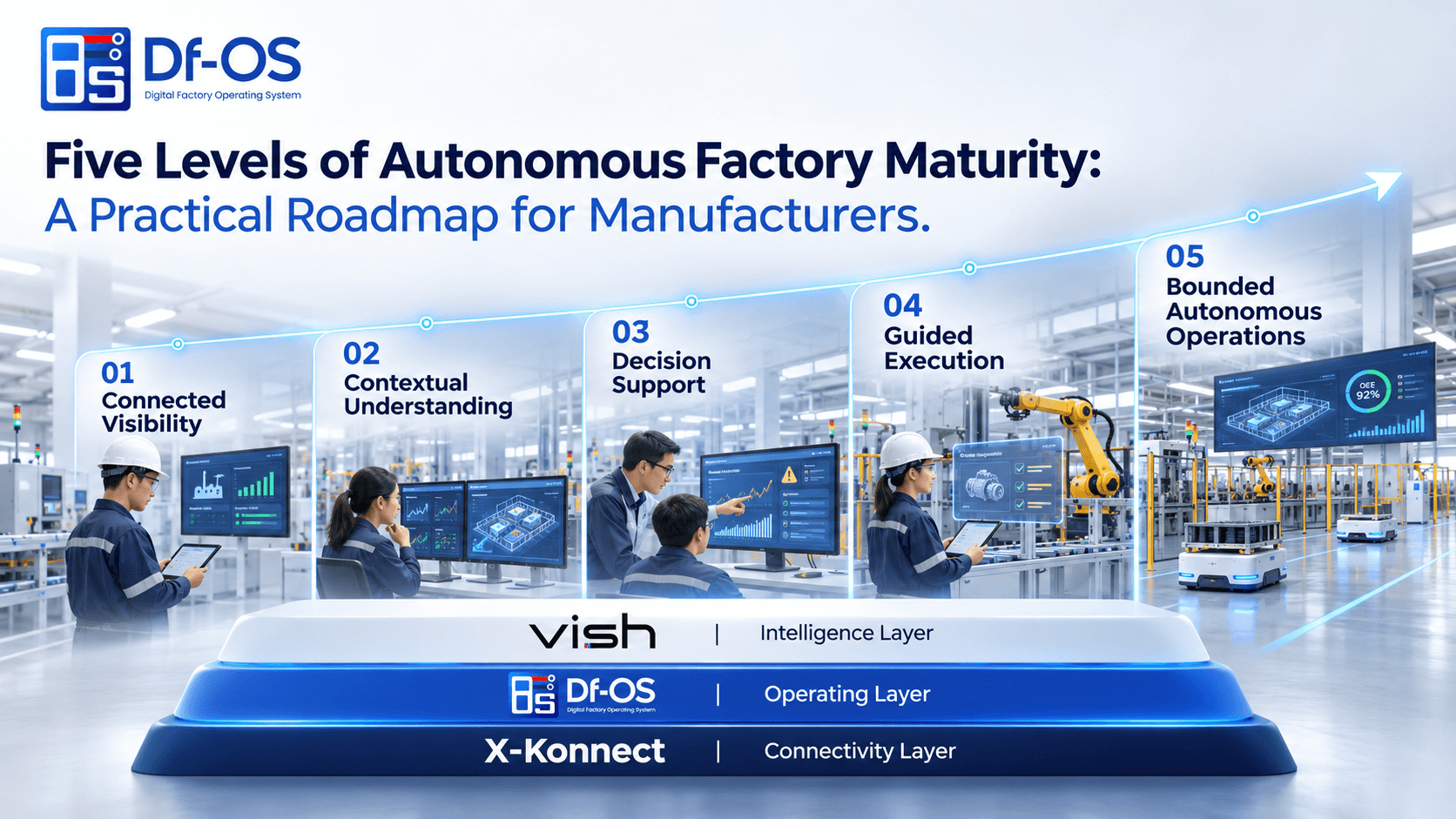
Five Levels of Autonomous Factory Maturity: A Practical Roadmap for Manufacturers
A practical roadmap for assessing factory autonomy at the level of operating decisions, from connected visibility and context to guided and bounded execution.
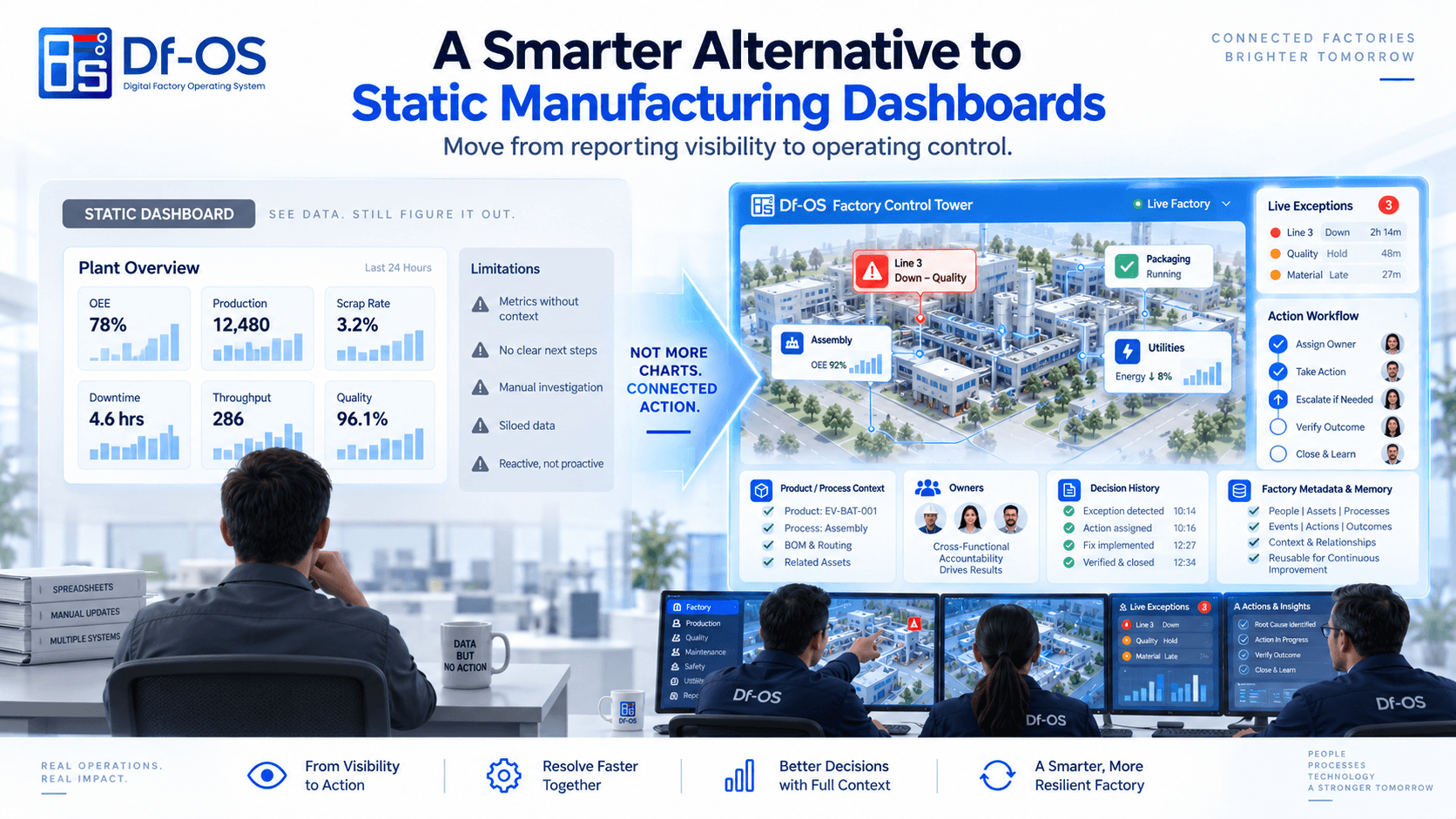
A Smarter Alternative to Static Manufacturing Dashboards
A comparison of static manufacturing dashboards and a connected Factory Control Tower that links metrics to live events, context, owners, workflows, escalation and verified closure.