
Digital Thread vs Factory Metadata & Memory
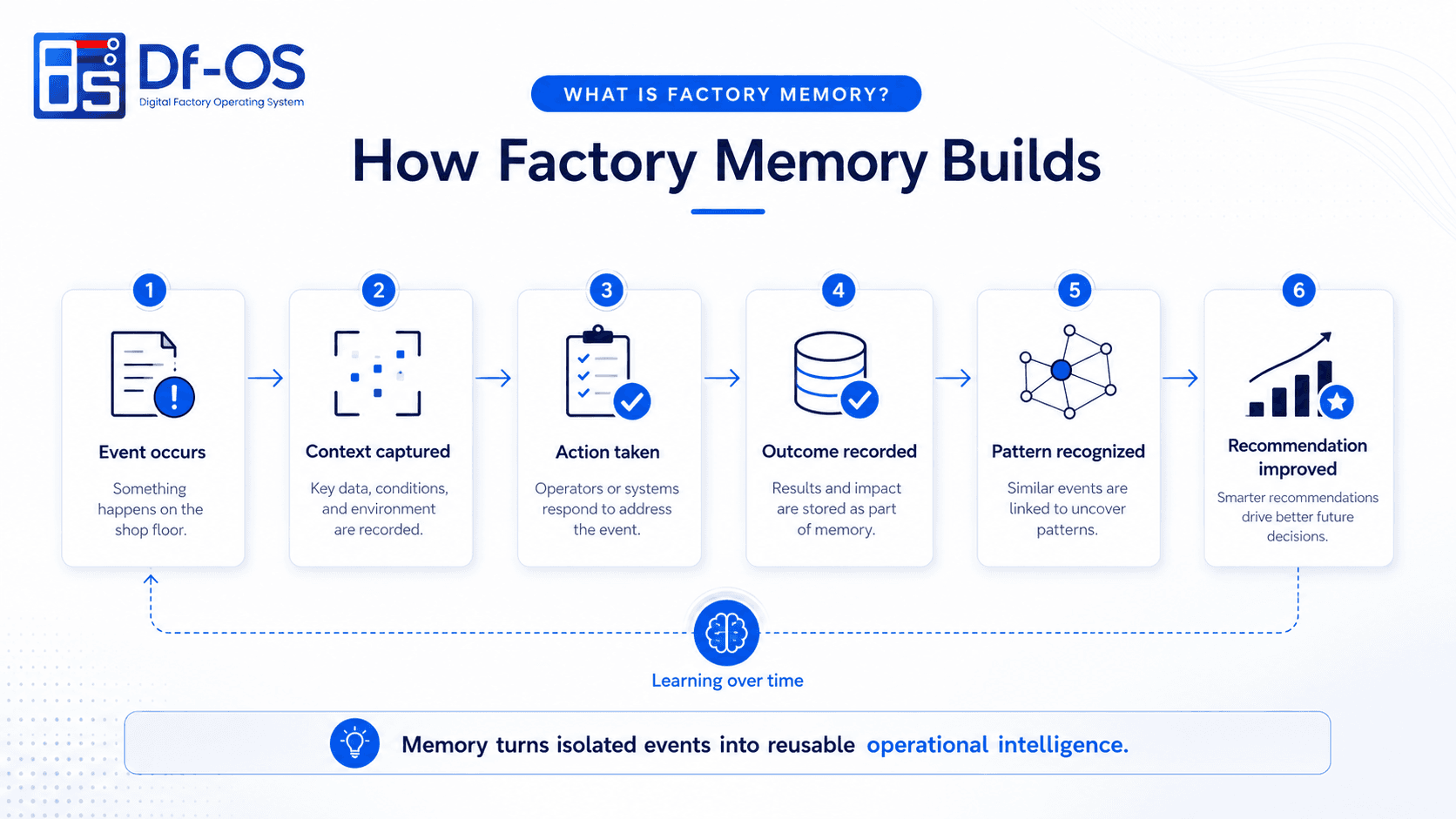
A digital thread follows information across the lifecycle of a product, production system or asset. Factory Metadata & Memory preserves the operating context and decision history created while the factory is running.
The concepts overlap, but they are not interchangeable.
A digital thread may tell the organisation which design, material, process plan, production record and inspection result belong to a product. Factory Metadata & Memory explains what happened during execution, which conditions were present, who responded, what decision was made and whether the action worked.
Manufacturers need to understand the difference because each concept solves a different traceability problem.
What is a digital thread?
A digital thread connects information across stages of a lifecycle.
Depending on the scope, it may connect:
- Requirement
- Design
- Engineering change
- Process plan
- Production order
- Material genealogy
- Inspection
- Service
- Asset maintenance
- End of life
The purpose is continuity. People and systems can trace how an object evolved and which information belongs to it.
A product digital thread may follow a serialised item. An asset digital thread may follow a machine from design through maintenance. A production system thread may connect process design and execution.
What is Factory Metadata & Memory?
Factory Metadata & Memory focuses on operating events.
It connects:
- The condition observed
- The plant, line, asset and process step
- The product, batch and material
- The shift and role
- The workflow triggered
- The decision and approval
- The action taken
- The response time
- The verified outcome
- Similar prior events
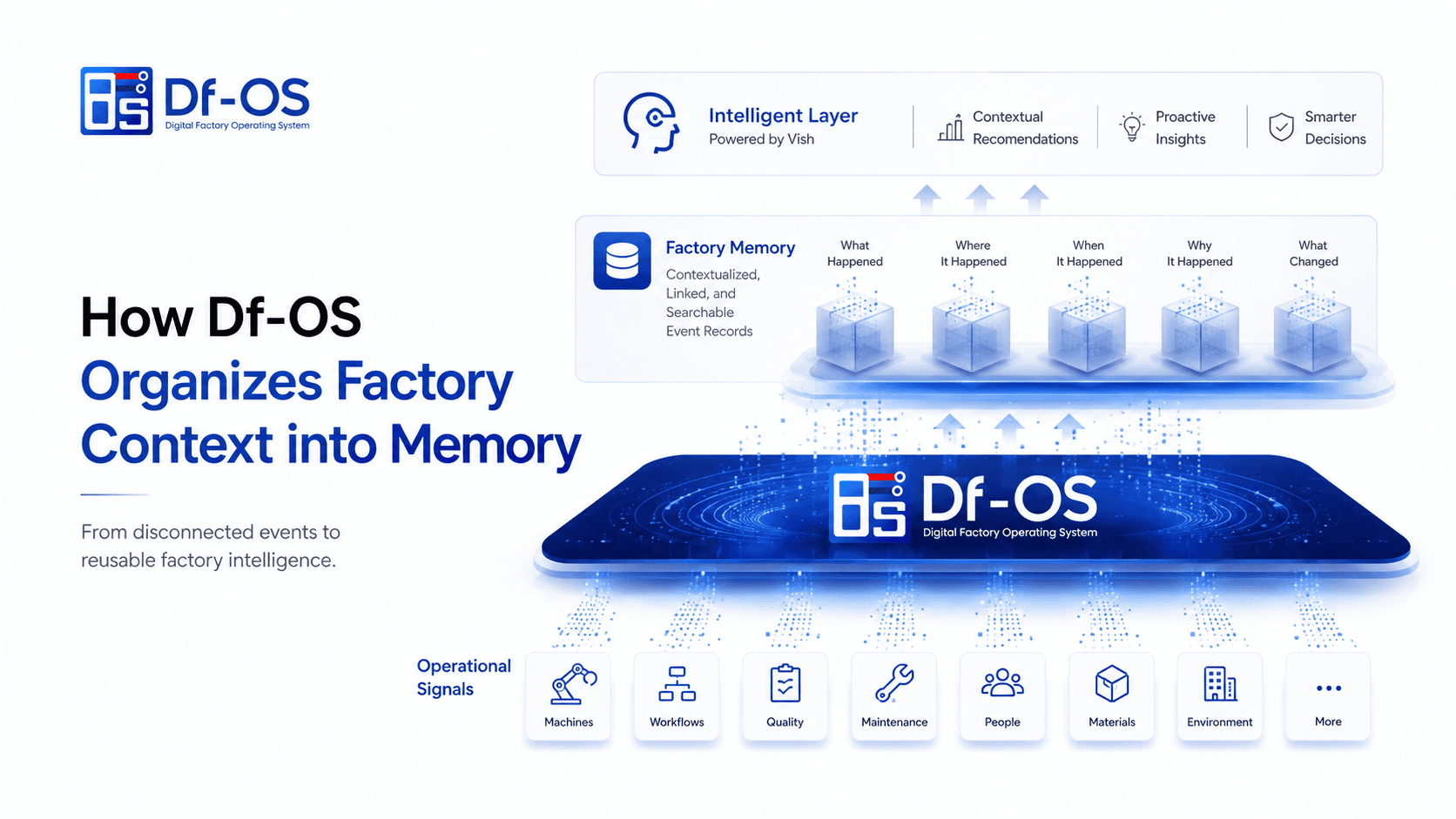
The purpose is operational understanding and reuse.
The architectural difference
Question | Digital thread | Factory Metadata & Memory
- What does it follow?: Product, asset or system lifecycle — Factory events, workflows and decisions
- Main purpose: Continuity and traceability across lifecycle stages — Context, action history and operational learning
- Typical users: Engineering, quality, manufacturing, service — Operators, supervisors, quality, maintenance, plant leadership and industrial intelligence
- Time view: Long lifecycle — Real time and historical operation
- Core relationship: Object and its related records — Event, condition, people, workflow, decision and outcome
- Main value: Trace what changed and where information came from — Explain what happened and what response worked
Where the concepts meet
The digital thread and Factory Metadata & Memory can strengthen each other.
Consider a quality deviation.
The digital thread may identify:
- The product design revision
- The material specification
- The supplier lot
- The process plan
- The inspection requirement
- The affected serial or batch
Factory Metadata & Memory may add:
- The machine condition
- The actual process value
- The shift and operator observation
- The open maintenance issue
- The containment decision
- The RCA and CAPA
- The verified outcome
Together, they provide both lifecycle traceability and operating explanation.
Why the distinction matters for intelligence
A model trained on lifecycle records may know which documents belong to a product. It may not know why a shift made a particular decision.
A model using Factory Metadata & Memory can examine the conditions, actions and outcomes around operating events. This context is essential for questions such as:
- Why did this deviation occur only on the night shift?
- Which corrective action prevented recurrence?
- What happened before the repeated stoppage?
- Which process condition changed after the new material lot arrived?
Reliable industrial intelligence often needs both object history and operating history.
A simple test
Ask two different questions.
Question 1: Which design revision, material lot and process plan were used for this batch?
This is primarily a digital thread question.
Question 2: What conditions were present when the batch deviated, who responded and what action worked?
This is a Factory Metadata & Memory question.
The factory should know which architecture answers each question.
The role of Df-OS
Df-OS creates the operating record across daily factory workflows, machine events and decisions. X-Konnect brings machine context into that record. Vish AI can then use Factory Metadata & Memory to explain events and support action.
Df-OS can integrate with systems that hold product, engineering, ERP, MES and quality lifecycle information. This allows Factory Metadata & Memory to strengthen the operational part of a wider digital thread.
How both support the Autonomous Factory
Autonomous operations need current operating context, but they also benefit from lifecycle rules and traceability.
A system may need to know:
- Which product and process plan are active
- Which control limits apply
- What condition is occurring
- Which action is approved
- What happened in similar events
- Whether the action corrected the issue
The digital thread provides important object and specification context. Factory Metadata & Memory provides event and decision context.
A design checklist
- Define the product, asset and process objects that require lifecycle traceability
- Define the factory events that require operating context
- Identify the source of record for each object
- Create common identifiers between lifecycle and operating records
- Capture decisions and outcomes, not only source data
- Make the history searchable for people and intelligence systems
- Preserve governance and access rights
Final perspective
The digital thread tells the story of the product and asset across their lifecycle. Factory Metadata & Memory tells the story of how the factory operated.
Manufacturers do not need to choose one concept. They need to design the relationship between them.
Ready to Modernize Your Factory Operating Layer?
Discover how Df-OS digitizes shopfloor workflows, connects brownfield machines, and creates Factory Metadata & Memory without rip-and-replace disruption.
Frequently Asked Questions
It can become the operational part of a broader digital thread, but it has a distinct focus on events, workflows, decisions and outcomes.
Stay Ahead of Manufacturing AI
Join 15,000+ plant managers and industrial leaders receiving our bi-weekly reports on AI agents, shopfloor data operations, and the future of smart factories.
Df-OS Editorial Board
Industry experts mapping the future of connected digital factory operating systems and manufacturing intelligence.
Related Insights & Guides
Why Shift Handover Is a Data and Context Problem
A reliable shift handover transfers operating context, risks, actions and decisions - not just output numbers or a spreadsheet.
What a 4M Knowledge Graph Means on the Shopfloor
See how a 4M knowledge graph connects Man, Machine, Material and Method around factory events so teams can analyse relationships instead of isolated records.
Building Factory Metadata Without Rip and Replace
Build Factory Metadata & Memory around existing brownfield assets and systems by starting with one operating event and expanding the connected context in phases.